
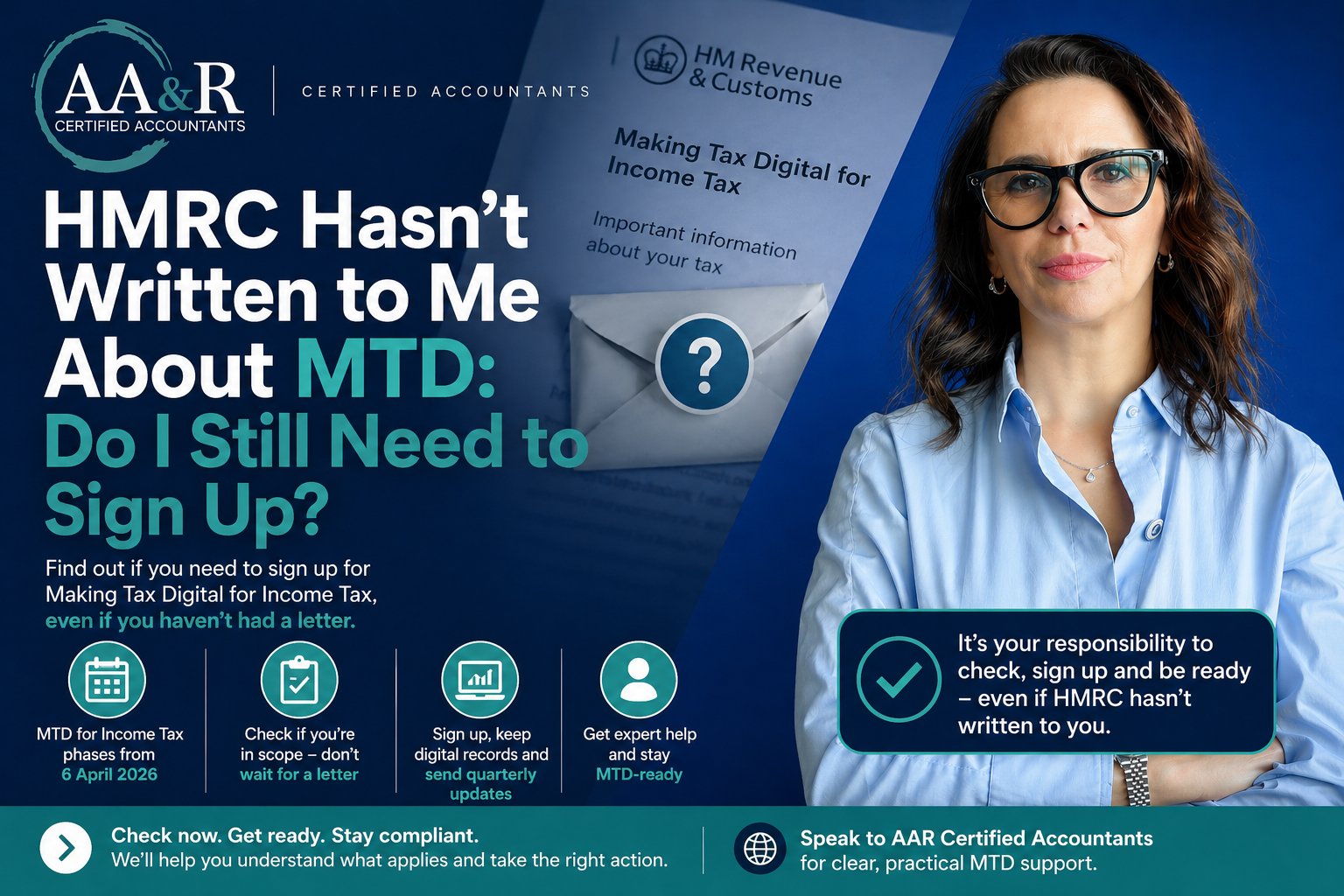
If HMRC has not written to you about Making Tax Digital for Income Tax, it can be tempting to assume you are not affected yet. In many cases, that assumption could be wrong.
HMRC guidance makes it clear that even if you do not receive a letter, it is still your responsibility to check whether you need to use Making Tax Digital for Income Tax and be ready in time.
For sole traders and landlords, this matters now because the first phase started on 6 April 2026 for people with qualifying income over £50,000.
The short answer is yes: if you meet the rules, you may still need to sign up even if no letter has arrived.
What HMRC Says About Not Receiving a Letter
HMRC says it will usually write to taxpayers whose qualifying income is above the relevant threshold. However, not receiving a letter does not automatically mean you are outside the rules.
You still need to check whether you need to use the service, when you need to start, and whether you should sign up.
That means the letter is helpful, but it is not the rule. Your obligation is based on whether you fall within Making Tax Digital for Income Tax, not simply on whether HMRC has contacted you yet.
Who Needs to Use Making Tax Digital for Income Tax?
Making Tax Digital for Income Tax applies in phases.
- From 6 April 2026, you need to use it if your qualifying income was over £50,000 for the 2024 to 2025 tax year.
- From 6 April 2027, the threshold drops to over £30,000, based on the 2025 to 2026 tax year.
- From 6 April 2028, it drops again to over £20,000, based on the 2026 to 2027 tax year.
In broad terms, this applies to sole traders and landlords with Self Assessment income from self-employment, property, or both.
HMRC looks at qualifying income. This means gross income from those sources before expenses are deducted, not profit.
Why You Might Not Have Had a Letter
There are several possible reasons why you may not have received a letter from HMRC.
- HMRC may still be processing information from your tax return.
- Your circumstances may be more complicated than a straightforward sole trader or landlord case.
- Your contact details may not be up to date.
- You may have assumed your profit was the key number, when HMRC is actually looking at gross income.
- You may be close to the threshold and unsure whether particular income sources count.
Whatever the reason, the safest approach is not to wait for a letter if you think your income could bring you into scope.
How to Check Whether You Need to Sign Up
Start with HMRC’s own checker for Making Tax Digital for Income Tax. HMRC provides a tool to help you check whether you need to use the service, when you need to start, and whether you may be exempt.
Before checking, gather the right figures. Look at your self-employment income and property income for the relevant tax year and focus on the turnover or gross income figure, not the profit after expenses.
You should also remember that having more than one qualifying income source can push you over the threshold. For example, a sole trader with rental income may need to add both together.
What to Do If You Think You Are in Scope
If your figures suggest you should already be using Making Tax Digital for Income Tax from 6 April 2026, HMRC guidance says you should sign up now.
Before you sign up, make sure you:
- are registered for Self Assessment
- have submitted a tax return within the last 2 years
- understand which income sources need to be included
- have software that works with Making Tax Digital for Income Tax, or an accountant who can help manage the process
You will also need to start keeping digital records and be ready to send quarterly updates through compatible software.
What If You Think HMRC Is Wrong, or You May Be Exempt?
Not every taxpayer who is worried about Making Tax Digital needs to sign up straight away.
If you think you should not be in scope, you should check your position carefully and contact HMRC if needed.
If you may be exempt, for example because you are digitally excluded, you may not need to use Making Tax Digital for Income Tax. HMRC has separate exemption guidance and, in some cases, you will need to apply rather than assume the exemption applies automatically.
This is one reason a quick review with an accountant can save time. It is much easier to confirm the position early than to untangle it after deadlines have started.
Common Mistake: Waiting for HMRC to Tell You Everything
A lot of business owners still think Making Tax Digital begins only when HMRC sends a letter. That is understandable, but it is not how the rules work.
The real trigger is your qualifying income and the start date that applies to you.
If you wait for a letter that never comes, you may leave yourself too little time to choose software, organise digital records, and understand what quarterly reporting will involve.
A better approach is to check now, confirm your position, and get ready before it becomes urgent.
How AA&R Certified Accountants Can Help
If you are unsure whether you need to sign up for Making Tax Digital for Income Tax, AA&R Certified Accountants can help you check your qualifying income, review whether all of your income sources count, and explain what action you need to take.
We can also help you get ready with the practical side of Making Tax Digital, including digital record-keeping, software setup, and ongoing reporting support.
If HMRC has not written to you but you think you may be affected, this is a good time to get clarity.
Need Help Checking Your MTD Position?
If you are unsure whether you need to sign up for Making Tax Digital for Income Tax, speak to AA&R Certified Accountants.
We can help you check what applies, understand your next steps, and get your records ready before deadlines become a problem.
Contact AA&R Certified Accountants today for clear, practical MTD support.
Suggested Internal Links
- How to Work Out Your MTD Qualifying Income for 2026
- The Biggest Misconception About MTD Quarterly Updates
- Do I Need to Register for Making Tax Digital? A Simple UK Checklist for 2026
- Making Tax Digital 2026: What Happens If You’re Not Ready?
Sources
- HMRC: Find out if and when you need to use Making Tax Digital for Income Tax
- HMRC: Sign up for Making Tax Digital for Income Tax
- HMRC: Apply for an exemption from Making Tax Digital for Income Tax
Disclaimer: This article is for general information only and does not constitute personalised tax advice. HMRC guidance and legislation can change, and the right approach depends on your circumstances.