
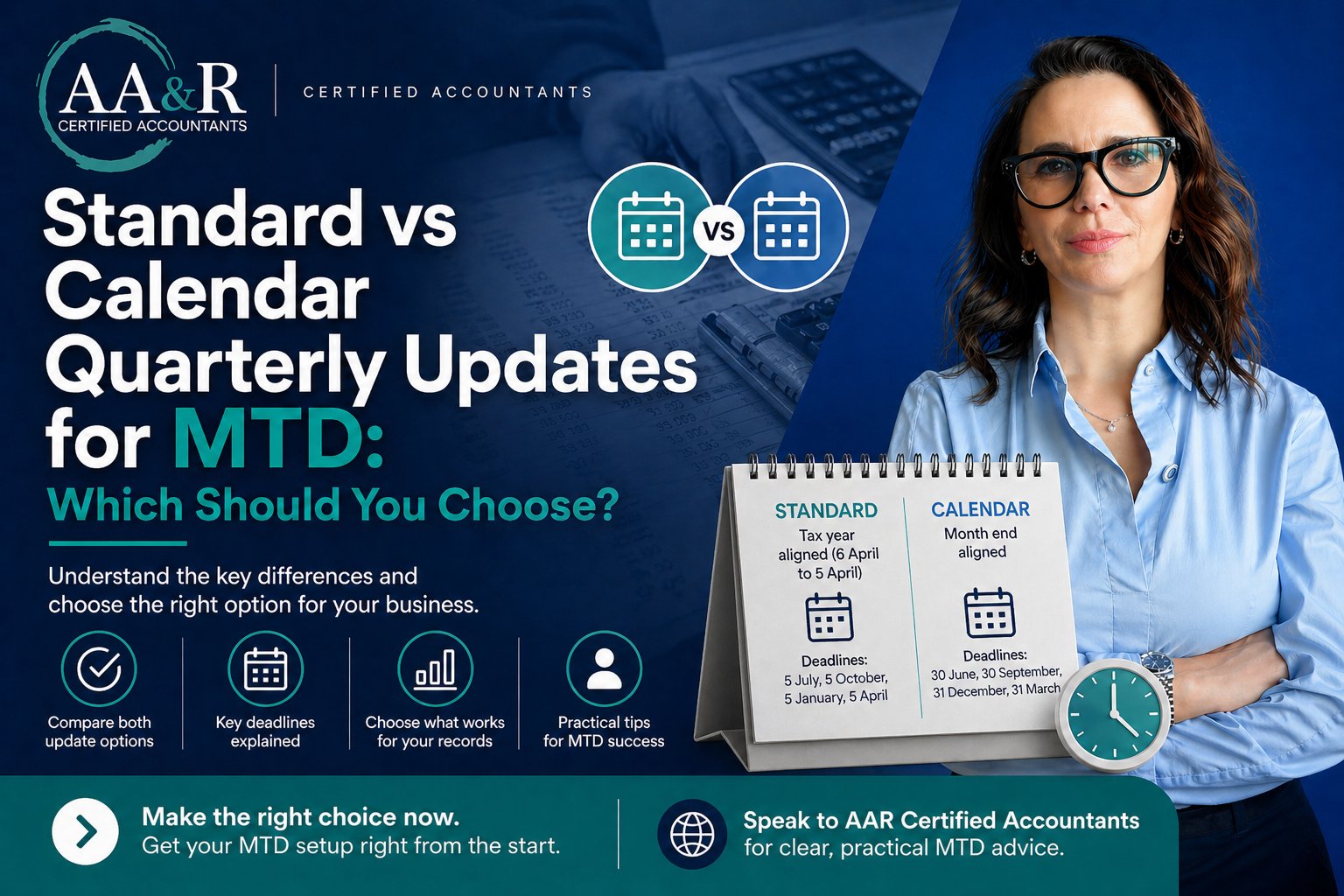
When you start using Making Tax Digital for Income Tax, one of the practical setup decisions is how your quarterly update periods will work.
For many sole traders and landlords, this question gets missed because most of the attention goes on thresholds, deadlines and software. But choosing the right update period can make your bookkeeping either much easier or much more awkward.
HMRC’s current guidance confirms there are two options for Making Tax Digital for Income Tax:
- standard update periods
- calendar update periods
The best choice depends mainly on when you keep your records and whether your accounting period lines up neatly with the tax year or with the end of a month.
What Are Standard Update Periods?
Standard update periods are aligned to the tax year, which runs from 6 April to 5 April.
HMRC says you should use standard update periods if your accounting period already aligns with the tax year. In practice, that means they are usually the more natural option if your records already run from 6 April to 5 April.
The standard update deadlines are:
- period ending 5 July, deadline 7 August
- period ending 5 October, deadline 7 November
- period ending 5 January, deadline 7 February
- period ending 5 April, deadline 7 May
These dates will feel familiar if you want your MTD process to follow the tax year closely.
What Are Calendar Update Periods?
Calendar update periods end on the last day of a month rather than on the fifth.
HMRC says that if your accounting period does not align with the tax year, for example if you work to 1 April to 31 March, calendar update periods will make your record keeping simpler.
The calendar update deadlines are:
- period ending 30 June, deadline 7 August
- period ending 30 September, deadline 7 November
- period ending 31 December, deadline 7 February
- period ending 31 March, deadline 7 May
For many businesses and landlords, these dates are easier to work with because they match month-end routines and common bookkeeping habits.
Why Does the Choice Matter?
At first glance, the difference between the two options may not seem very important. But it affects how cleanly your records match your normal bookkeeping process.
If you naturally work to month-end, calendar update periods can reduce friction. If you naturally work to the tax year, standard update periods may feel simpler.
That matters because MTD is not only about sending updates on time. It is also about creating a process you can keep up with throughout the year.
When Standard Update Periods May Be the Better Choice
Standard update periods will usually suit you if:
- your accounting period already runs from 6 April to 5 April
- you prefer to follow the tax year exactly
- your bookkeeping process is already built around Self Assessment timing
- you want your quarterly dates to line up directly with the MTD tax-year structure
For some sole traders, this keeps everything in one system and avoids extra mental adjustments.
When Calendar Update Periods May Be the Better Choice
Calendar update periods will usually suit you if:
- your records are prepared monthly to the end of each month
- your accounting period ends on 31 March
- you want simpler month-end bookkeeping
- your software and bookkeeping routine are built around calendar months
This can be especially useful if you already review income and expenses at the end of each month and do not want odd dates like the fifth of the month disrupting that process.
One Important Point People Miss
HMRC says that if you want to use calendar update periods, you need to select calendar update periods in your software before your first update is made for the tax year.
That is important.
You cannot leave the decision until after the first quarterly update has already gone in and then switch back and forth freely. HMRC says if you want to return to standard update periods, you must choose that before the first update is made for the tax year. Once you have sent an update, you cannot go back to standard periods until the next tax year.
So this is a setup choice to make early, not a detail to tidy up later.
Does One Option Change Your Tax Bill?
No.
Choosing standard or calendar update periods does not change how much tax you pay. It changes the reporting rhythm, not the underlying tax rules.
The real benefit is administrative. The right option helps your bookkeeping flow more naturally and reduces the chance of mistakes, rushed updates or year-end confusion.
What About Year-End Adjustments?
You still need to deal with year-end adjustments after your fourth quarterly update.
If you choose calendar update periods, HMRC’s guidance says you may need to make an adjustment at the end of the first tax year to bring the figures into line where needed. That is one reason it is sensible to choose your reporting method with proper advice rather than guessing.
How Should Landlords Think About This?
Landlords often find calendar update periods easier when their records are already organised monthly. Rent schedules, agent statements and recurring costs often fall naturally into month-end reporting.
But that does not mean calendar periods are always right. If your wider records are already structured around the tax year, standard periods may still be more practical.
How Should Sole Traders Think About This?
For sole traders, the decision usually comes down to bookkeeping habits.
If you already reconcile monthly and prefer clean month-end reporting, calendar periods may save time. If you only want to think in tax-year terms, standard periods may be simpler.
The right answer is usually the one that matches how you actually keep records, not the one that sounds more familiar.
A Simple Way to Decide
Ask yourself these questions:
- Do I already keep records to the end of each month?
- Does my accounting period end on 31 March?
- Will my software be easier to manage on a calendar-month basis?
- Am I likely to keep up with MTD more consistently if the dates match my current routine?
If the answer to most of these is yes, calendar update periods may be the better fit.
If not, standard update periods may be the cleaner choice.
How AA&R Certified Accountants Can Help
We help sole traders and landlords choose the reporting setup that fits their bookkeeping, software and year-end process before MTD becomes a problem.
If you are unsure whether standard vs calendar quarterly updates MTD rules make more sense for your business, AA&R Certified Accountants can help you choose the right option and get your MTD setup right from the start.
Disclaimer: This article is for general information only and does not constitute personalised tax advice. HMRC guidance and legislation can change, and the right approach depends on your circumstances.